
By: Mohamed S Shaharan
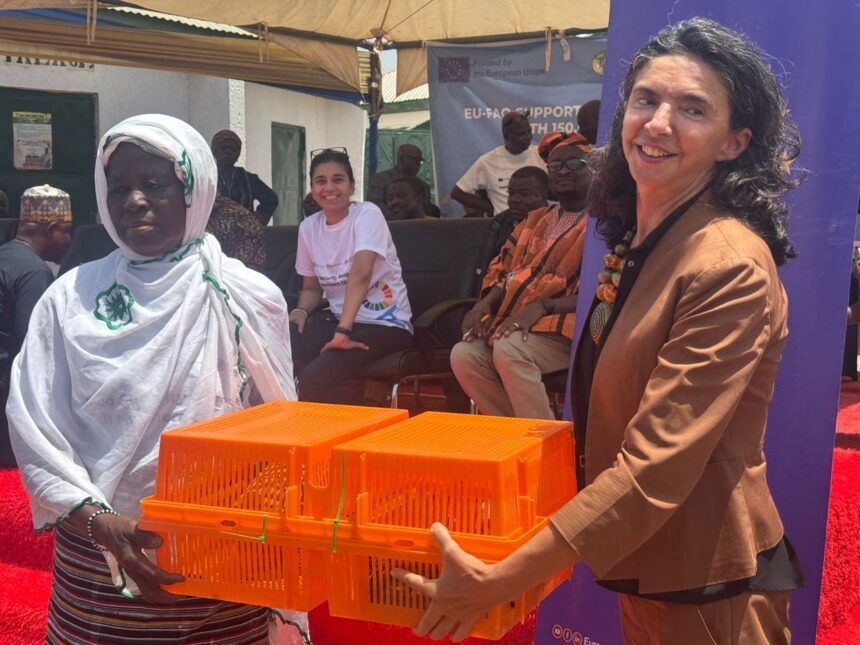
The European Union (EU) has reinforced Ghana’s efforts to revamp its poultry industry with the donation of 150,000 fully vaccinated birds to 3,000 farmers across six districts in the Savannah, Upper East, and Northeast regions.
The support, which also includes poultry feed and essential veterinary medication, is being delivered under the EU-funded Food Security Response Northern Ghana Project.
The initiative is implemented by the Food and Agriculture Organization (FAO) in collaboration with Ghana’s Ministry of Food and Agriculture (MoFA).
The intervention is expected to directly benefit about 15,000 rural households, targeting improvements in food security, job creation, and household incomes.
It also aims to strengthen Ghana’s poultry value chain and reduce the country’s heavy reliance on imported chicken, which currently costs between $300 million and $400 million annually.
Speaking through a representative at Gbung in the Northeast Gonja District, the EU Ambassador to Ghana Rune Skinnebach, emphasized that agriculture and food security remain central to EU-Ghana cooperation.
He noted that the initiative would not only enhance local poultry production but also promote sustainable livelihoods and job opportunities, especially as all inputs for the project are sourced locally.
On his part, the Minister for Food and Agriculture, Eric Opoku, emphasised that increasing local poultry production would help lower the cost of chicken and improve food security.
“Our aim is to make poultry more affordable to Ghanaians while providing sustainable income opportunities, especially for rural households,” he noted.
He further highlighted the government’s commitment under the Feed Ghana Programme to achieve full self-sufficiency in poultry production within three years.
According to him, increasing local production will reduce import costs, make poultry products more affordable, and provide sustainable income opportunities for rural households.
Also speaking on the initiative, the FAO Representative to Ghana, Priya Gujadhur, underscored the importance of capacity building under the project.
She revealed that beneficiary farmers have received hands-on training in poultry management and agribusiness skills, enabling them to sustainably manage their operations and expand production.
Beyond the supply of birds and inputs, the programme includes the establishment of hatcheries and continued technical training to help farmers scale up production and improve efficiency.